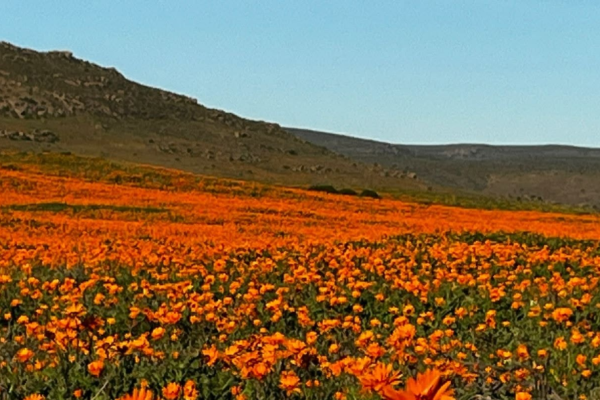
South Africa is famous for its wildlife, its beaches, mountains, and vineyards, but for a few weeks each year, there is something else that is in the spotlight and its South Africa’s famous wildflower phenomenon. If you are familiar with the dry, semi-arid desert of Namaqualand and the West Coast, you’ll be spellbound as you see it turning into a carpet of colourful flowers. If you can get to see them, they bloom from mid-August to mid-September. The wildflowers interestingly only open their petals in warm, direct sunshine. What an amazing, spectacular sight it is to see vast carpets of orange, yellow, pink, white, purple and blue stretches of flowers across the plains, hills and valleys of the Northern and Western Cape.
A Few Practical Guidelines for Your Trip
- Visit on sunny days, preferably in the morning, when many flowers are fully open
- Avoid stepping on flowers, even when the blooms appear abundant
- Stay on marked roads and paths, especially in protected areas
- Carry water, sunscreen and a hat
- Bring binoculars and a camera
- Never ever collect plants
- Always check storm and road conditions
- Respect private land and never enter private property without permission
- Book your trip and accommodation early
Below are some of the best places to see South Africa’s wildflowers, along with accommodation ideas that make it easier to explore each region.
Namaqualand – the ultimate wildlife experience
If there is one destination synonymous with South Africa’s wildflowers, it’s Namaqualand. So, what appears to be barren countryside for much of the year suddenly becomes this vast natural garden filled with daisies, vygies, gazanias, lilies and countless smaller flowering plants.
SANParks notes that the region contains more than 1,000 plant species found nowhere else on Earth.
Namaqua National Park
One of the best places to experience the Namaqualand flower season is Namaqua National Park, where the Skilpad area is particularly famous for its spring display.
The park offers walking trails, viewpoints, and a circular drive during flower season, allowing visitors to experience the flowers rather than simply viewing them from a roadside.
Where to stay: For exploring Namaqualand, consider staying in the wonderful Namaqua National Park. It is found in the Succulent Karoo, stretching from the Skilpad section, near Kamieskroon, on the escarpment westwards to the coast. The Skilpad Rest Camp offers its visitors self-catering accommodation in its four chalets, while the Namaqua Flower Beach Camp offers its visitors a fabulous stay in an exclusive, luxury tented retreat where they can experience both the wildflowers and the ocean. You have to bear in mind that the Namaqua Flower Beach Camp is only open for 4 weeks a year and only during the Flower Season. The first signs of the world-renowned Namaqualand wildflower season already start in July in the park.
Accommodation in the region ranges from hotels and lodges to guesthouses and self-catering cottages. In Kamieskroon, travellers can look for small local guesthouses such as Kamieskroon Cosy Cottage or Thys’e Kombuis & Guest House. At the same time, Springbok has super establishments, including Kleinplasie Guesthouse and Annies’s Cottage that promises a romantic getaway for those wanting to see South Africa’s wildflowers.
Nieuwoudtville – South Africa’s bulb capital
For serious flower enthusiasts, Nieuwoudtville is an essential stop as the small Northern Cape town sits on the Bokkeveld Plateau and is famous for an extraordinary concentration of bulbs and other flowering plants.
The Hantam National Botanical Garden, managed by SANBI, covers more than 6,000 hectares and protects several distinctive vegetation types. More than 1,350 different types of flowers have been recorded here, including numerous species endemic to the Bokkeveld Plateau.
The garden is particularly special because it offers more than one flowering season. Its famous spring flower season coincides with the broader Namaqualand season, while an autumn display of March lilies provides another spectacular botanical event.
Nieuwoudtville is also home to some exceptionally rare flowers. The landscape’s unique soils and geological conditions support an extraordinary concentration of bulb species. SANBI notes that some areas can contain around 50 different species within a single square metre.
Nieuwoudtville is less about simply seeing a huge carpet of daisies and more about discovering the astonishing variety of South Africa’s indigenous flora.
Take time to walk, look closely and appreciate the tiny flowers growing among the larger blooms.
Cool places to stay around Nieuwoudtville and Matjiesfontein include several charming farm and guesthouse options. Oudeklip Guesthouse offers semi-self-catering accommodation in a historic sandstone building in town, while close to Matjiesfontein is Keurkloof Guest Farm with its fabulous self-catering cottages surrounded by the area’s famous flowers.
Clanwilliam and the Cederberg
The town of Clanwilliam is another excellent base for exploring South Africa’s spring flowers.
Situated below the Cederberg Mountains, Clanwilliam offers easy access to several flower-viewing areas and is also home to the annual Clanwilliam Wild Flower Show, which celebrates the region’s extraordinary botanical diversity.
Clanwilliam has a good selection of guesthouses and self-catering accommodation. Why not base yourself in Clanwilliam for 3 nights or so? You can do day trips to Niewoudtville, the Biedouw Valley and the West Coast.
The circular drive to Nieuwoudtville via the Botterkloof and Van Reyns Passes is simply stunning! There is fabulous accommodation in Clanwilliam, whether you’re looking for family accommodation, pet-friendly accommodation, couple’s accommodation, accommodation that provides a romantic getaway, or you require wheelchair friendly accommodation. For farmstays you might like Bovlei Guest Farm, but in town, The Yellow Aloe Guest House is a fabulous choice as well as the sweet little, romantic Daisy Cottage.
The West Coast flower route
You do not necessarily need to choose just one destination.
One of the best ways to see South Africa’s wild flowers is to create a road trip through the Western Cape and Northern Cape.
A route could include:
- Cape Town
- Darling and the surrounding West Coast
- Langebaan
- West Coast National Park
- Clanwilliam
- Biedouw Valley
- Nieuwoudtville
- Namaqualand
- Namaqua National Park
The advantage of travelling this way is that flowering conditions can vary dramatically from one area to another. If flowers are fading in the south, they may still be spectacular further north.
The journey itself becomes part of the experience, with quiet country roads, mountain passes, tiny towns and unexpected patches of flowers along the way.
Langebaan, for instance, makes an excellent base for a West Coast flower trip. Tranquility: Langebaan offers self-catering accommodation close to the lagoon.
Agulhas National Park – flowers at the southern tip
Wildflowers are not restricted to the West Coast and Northern Cape.
Agulhas National Park, around the southernmost tip of Africa, is another fascinating destination for anyone interested in South Africa’s plant diversity.
The Agulhas Plain contains around 2,000 species of indigenous plants, including about 100 endemic species. The area forms an important part of the Cape Floristic Kingdom and contains unusual vegetation types including limestone fynbos and Elim fynbos.
You can explore the flowers while also visiting Cape Agulhas, the southernmost tip of Africa, historic lighthouses, coastal landscapes and nearby seaside towns.
When visiting Agulhas National Park, staying in Cape Agulhas or Struisbaai gives you easy access to the park and surrounding coastal attractions. There are numerous guesthouses, cottages and self-catering holiday homes in the area, making it an easy destination to combine with a longer Overberg road trip. Take a look at The Agulhas Country Lodge, which is super accommodation
The Northern Cape flower fields
Beyond Namaqua National Park, the wider Northern Cape is full of opportunities to experience spring flowers.
One of the great pleasures of travelling through the region is that the flowers are not always neatly contained within a reserve. After good rains, roadsides, farm fields and open veld can become covered with flowers.
This is where a wildflower road trip becomes particularly rewarding.
Keep your camera ready and allow plenty of time. The best flower photographs are often found when you stop somewhere that was not originally on your itinerary. For a Northern Cape flower road trip, Springbok, Kamieskroon and the smaller Namaqualand towns offer a selection of guesthouses, lodges and self-catering cottages. Booking early is essential during the short flower season, particularly in August and September.
A flower season worth travelling for
South Africa’s wildflowers are more than a beautiful seasonal attraction. They are a reminder of just how extraordinarily rich the country’s natural heritage is.
From the seemingly endless daisy fields of Namaqualand to the delicate bulbs of Nieuwoudtville, the flowers of the West Coast and the rugged landscapes of the Cederberg, every region offers something different.
The best places to see South Africa’s wild flowers are therefore not necessarily just one famous destination. They are part of a wider journey through some of the country’s most beautiful and fascinating landscapes.
If you have never experienced the spring flower season, put it on your South African travel bucket list. And if you have been before, you will understand why so many visitors return year after year – because no two flower seasons are ever quite the same.
Frequently Asked Questions
When is the best time to see wild flowers in South Africa?
The main wildflower season is generally August and September, particularly in Namaqualand and along the West Coast. Flowering depends on winter rainfall and weather conditions, so exact timing varies each year.
Where is the best place to see wildflowers in South Africa?
Namaqualand, Namaqua National Park and West Coast National Park are among the country’s most famous flower-viewing destinations. Nieuwoudtville is particularly rewarding for visitors interested in bulbs and botanical diversity.
Are South Africa’s wild flowers only found in the Western Cape?
No. The most famous flower routes are in the Western and Northern Cape, but spectacular indigenous flowers can also be found in places such as Agulhas National Park and other parts of the Cape Floral Kingdom.
What weather is best for seeing wild flowers?
Warm, sunny weather is ideal because many flowers open their petals in sunshine. Always check local flower reports before travelling because rainfall and temperatures can significantly affect the timing and quality of the display.
Can I pick wild flowers?
No. Wildflowers should be left where they grow. Many species are rare, endemic or part of protected ecosystems. Enjoy them, photograph them and leave them for the next visitor to discover.
Final Thoughts
South Africa’s wildflower season is much more than a colourful display. It is a celebration of the country’s extraordinary botanical heritage. The Cape Floral Kingdom contains an exceptional concentration of plant species, many of which are found nowhere else. Even the seemingly empty landscapes of the Karoo and Namaqualand support intricate ecological communities adapted to drought, heat and poor soils.
Whether you choose the famous daisy carpets of Namaqualand, the delicate bulbs of Nieuwoudtville, the coastal flowers of the West Coast or the mountain fynbos of the Overberg, a wildflower trip offers a chance to experience South Africa at its most surprising.
The best approach is to travel slowly, remain flexible and allow time for unplanned stops. A roadside patch of colour, a tiny flower growing among stones or a broad field glowing in the morning sun may become the highlight of the journey. With suitable accommodation—from rural guesthouses and farm stays to comfortable self-catering cottages—visitors can turn the flower season into a memorable exploration of South Africa’s landscapes, communities and natural heritage.
Found this helpful? Share it with someone planning a South African getaway.